Soft-Shell Crab Season From the Chesapeake Molting Cycle to the Dinner Table
Few Maryland seafood specialties are as closely tied to the natural life cycle of the blue crab as soft-shell crabs. Unlike hard-shell crabs, soft-shell crabs are harvested during a very specific stage of the crab’s growth. The crab has recently shed its hard outer shell, leaving behind a newly formed shell that is still soft and flexible. That short window creates the delicacy known as a soft crab. For anyone searching for Maryland soft shell crabs, understanding this process makes the food much more interesting. What appears on a seafood menu is actually the result of careful observation, timing, handling, and preparation. The process begins in the Chesapeake Bay. A blue crab grows by producing a new shell underneath its existing shell and eventually shedding the old one. Immediately after molting, the new shell is soft and vulnerable. Maryland DNR identifies crabs in this stage as soft crabs or soft-shell crabs. Cravin’ Crabs has a particularly direct connection to this process. The second-generation family business is operated by local watermen, and its owners describe monitoring crab bins around the clock so soft crabs can be harvested at the appropriate point in the molting process.
Cravin’ Crabs currently offers both live and frozen soft crabs, giving customers different ways to enjoy this distinctive Maryland seafood.
What Is a Soft-Shell Crab?
A soft-shell crab is not a different species of crab. It is a blue crab that has recently molted its hard outer shell. Blue crabs cannot simply grow larger inside their existing shells. Instead, they periodically form a new shell underneath the old one and shed the old shell. The new shell is initially soft and pliable, allowing the crab to expand as it takes in water. Maryland DNR explains that immediately after molting, the new shell is soft enough to stretch. Within a few hours it begins hardening, and a paper-shell stage develops within approximately 12 hours. The shell can become fully hardened within several days. That short period is what makes the soft crab so distinctive. Instead of cracking the hard shell away from the meat, properly prepared soft-shell crabs can be eaten largely whole after the appropriate cleaning and cooking process.
The Chesapeake Blue Crab Molting Cycle
To understand Chesapeake soft shell crab, it helps to understand how blue crabs grow.
A blue crab’s shell is its external skeleton. Because that shell cannot expand indefinitely, the crab must periodically molt.
Before molting, the crab develops a new, soft shell underneath the old one. Maryland DNR notes that changes around the swimming paddles can help indicate that a crab is approaching the molting stage. When the crab is ready to shed, it is commonly called a peeler or shedder.
The crab then separates itself from the old shell.
Once the old shell is left behind, the newly emerged crab is extremely vulnerable. Its new shell is soft, and the animal has not yet regained the protection provided by a hard exterior.
Maryland DNR notes that soft crabs are vulnerable to predators during this period, which is one reason submerged vegetation and other habitats can provide important refuge for molting crabs.
For commercial soft-crab operations, timing is therefore critical.
What Happens During the Molt?
The molting process is more complex than simply “changing shells.”
As the old shell separates, the crab must carefully work its body free. Once it emerges, it begins taking in water, which helps expand the newly formed shell.
Maryland DNR describes this process as a rapid transformation. The newly emerged crab’s shell is pliable, and water intake causes the new shell to expand. The agency notes that the new shell can become roughly 30 percent larger, point to point, than the old shell as it hardens.
Cravin’ Crabs describes a similar process on its dedicated soft-crab information page. Its explanation notes that a mature crab can take several hours to complete the molt and that the newly molted crab becomes increasingly vulnerable until the new shell starts to harden.
This narrow window is the reason soft-crab production requires careful monitoring.
If the crab remains in the water too long after molting, the shell begins progressing toward the next, harder stage.
For someone ordering a soft-shell crab, that biological timing is an important part of what makes the product special.
What Is Soft Crab Season?
Soft crab season refers to the period when blue crabs are actively molting and soft crabs become available for harvest. The exact availability can vary with water temperature, crab biology, environmental conditions, harvesting activity, and supply. Maryland’s commercial regulations separately recognize hard crabs, peelers, and soft crabs as different categories. Current Maryland DNR regulations specify a minimum size for commercially harvested soft crabs and establish the applicable harvest period under Maryland’s Chesapeake Bay regulations. This is different from saying that every soft crab will be available throughout the entire period. Soft crabs are naturally seasonal because the product depends on the molting stage of the blue crab. For customers, that means availability can change even within the broader soft-crab season. A seafood business may have soft crabs available at one point and limited availability later, depending on its current supply.
Why Timing Matters So Much With Soft Crabs
The defining feature of a soft crab is its shell condition.
That means timing affects the product in a way that is different from ordinary hard-shell crab.
A crab that has just completed its molt has a soft shell. If allowed to remain in the water, the shell begins hardening almost immediately. Cravin’ Crabs explains that within a few hours the shell starts becoming harder, with a paper-shell stage developing later and full hardening occurring over the following days. For a business specializing in Baltimore soft shell crab, handling these crabs correctly is therefore a specialized task. Cravin’ Crabs says its watermen continuously monitor molting crabs and remove them from the water after the crab has completed the molt. The business explains that this helps prevent the crab from continuing the shell-hardening process. The result is a product that preserves the defining characteristic customers are looking for: a genuinely soft shell.
How Cravin’ Crabs Handles Soft Crabs
Cravin’ Crabs has a particularly hands-on relationship with the soft-crab process.
According to the business’s current information, its owners are experienced local watermen with a family history connected to Chesapeake crabbing. The company says its crab bins are monitored continuously so the soft crabs can be harvested at the appropriate point after molting.
Its dedicated soft-crab page explains that the crabs are removed from the water after the molt and taken to a clean indoor facility for packaging. Some are frozen while others are packaged live. This is important because the handling stage begins before the customer ever receives the crab. The quality of a soft crab depends not only on cooking but also on what happens immediately after the molt. That is one reason experienced soft-crab suppliers pay close attention to the timing of the harvest.
Live Soft Shell Crabs vs. Frozen Soft Crabs
Cravin’ Crabs currently lists both live soft shell crabs and frozen soft crabs on its menu.
The two forms provide different purchasing options.
Live soft crabs allow customers to receive the product without freezing and prepare it at home.
Frozen soft crabs provide a more convenient option for customers who want to store the seafood and cook it later.
Cravin’ Crabs states that soft crabs can safely remain frozen for up to three months.
The business also explains that soft crabs are not cleaned before being frozen or packaged live. Instead, customers should clean them shortly before cooking.
This distinction is useful for anyone purchasing frozen soft crabs for home preparation.
The product may arrive ready for cooking in terms of its shell condition, but it still requires the appropriate cleaning step before it goes into the pan.
How to Clean a Soft Crab
Soft crab cleaning is relatively straightforward once you understand what needs to be removed.
Cravin’ Crabs recommends using sanitized scissors to remove the section around the eyes and mouth. The sides of the upper shell covering are then lifted so the crab’s internal gill structures, sometimes called the “devil,” can be removed.
The underside is then addressed.
The crab’s apron is opened and attached material is removed. Whether the apron itself is completely removed can be a matter of personal preparation preference, according to Cravin’ Crabs’ guide.
The cleaning process should be performed shortly before cooking.
This is especially relevant when working with live or frozen soft crabs because cleaning too early can affect how the product is stored and handled.
For anyone preparing Maryland soft crab preparation at home for the first time, following a clear cleaning process is essential.
Cooking Soft Shell Crabs at Home
Once cleaned, soft crabs can be prepared in several ways.
One traditional approach is pan-frying with a light coating.
Cravin’ Crabs’ preparation guide recommends coating the cleaned crab in seasoned flour, dipping it in an egg wash, and then coating it again with flour. It also notes that cornmeal can be used instead of flour for a different texture.
For a gluten-free preparation, the business suggests using the egg wash without the flour coating.
The coated crab is then cooked in butter or oil over medium-high heat until lightly golden brown.
This creates the crisp exterior that contrasts with the tender seafood inside.
Of course, preparation methods can vary. Some cooks prefer grilling, broiling, baking, or other approaches. The important consideration is that soft crabs are delicate and should be handled carefully throughout preparation.
Soft Crab Cooking: Getting the Texture Right
The appeal of soft crab cooking is largely about texture.
A well-prepared soft-shell crab should have a crisp or browned exterior while retaining tender crab meat inside.
Overcooking can work against that balance.
The crab does not require the same prolonged cooking approach associated with certain hard-shell seafood preparations. Instead, the goal is generally to cook the cleaned crab thoroughly while developing the desired exterior texture.
Cravin’ Crabs’ own method calls for cooking until lightly golden brown, with an approximate cooking time of around five minutes in a buttered pan.
Exact cooking time can vary depending on crab size, pan temperature, coating, and cooking method.
The visual and textural result is more useful than treating one cooking time as a universal rule.
What Does a Soft-Shell Crab Taste Like?
The flavor of a soft-shell crab combines the natural sweetness and richness of blue crab with the flavors introduced during cooking.
Because the shell remains soft, the eating experience is fundamentally different from a traditional hard-shell crab feast.
With hard-shell crabs, the meal involves cracking the shell, removing the edible portions, and picking the meat.
With soft-shell crabs, the shell becomes part of the finished dish after appropriate cleaning and cooking.
That changes both the texture and the presentation.
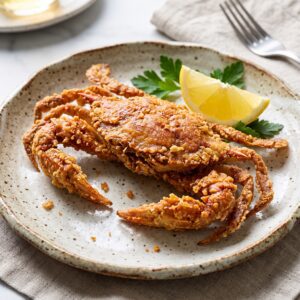
A crisp fried soft crab can have a delicate shell crunch on the outside, followed by tender crab meat inside.
The contrast is one of the reasons soft crabs have remained a sought-after Chesapeake seafood specialty.
Soft Crabs Maryland: Why They Are Part of the Local Seafood Tradition
Soft crabs are not simply another seafood menu item in Maryland.
They represent one of the most visible connections between a seafood dish and the biological cycle of the blue crab.
The Chesapeake Bay has long supported a major blue crab fishery. Maryland DNR identifies hard-shell crabs, peelers, and soft crabs as separate commercial market categories.
This means Maryland’s crab industry does not revolve solely around the familiar hard-shell crab.
The soft-crab stage is an important part of the broader blue crab fishery.
For generations, watermen and seafood businesses have developed specialized methods for identifying peelers, protecting molting crabs, monitoring holding conditions, and harvesting soft crabs at the right moment.
That specialized knowledge is part of the reason soft crabs Maryland are associated with Chesapeake seafood culture.
Soft-Shell Crab Availability in Baltimore
Customers searching for soft shell crabs Baltimore should understand that availability can be more variable than ordinary hard-shell crabs.
The reason is biological.
A seafood business cannot simply produce a soft crab whenever a customer places an order. The crab has to reach the appropriate stage of its natural molting cycle.
Environmental conditions and supply also affect availability.
Cravin’ Crabs currently lists live and frozen soft crabs, with sizes and prices shown on its menu. Its current menu states that soft-crab sizes range from $5 to $12, although prices are subject to change.
Because seafood availability can change, customers looking for a specific size or quantity should contact the business before making a trip.
Why Soft Crabs Are More Difficult to Handle Than Hard Crabs
Hard-shell crabs provide a certain amount of protection because their exterior skeleton is already hardened.
Soft crabs are much more delicate.
Immediately after molting, the new shell provides little physical protection. Maryland DNR notes that soft crabs are vulnerable to predators during this stage.
Commercial soft-crab operations therefore require specialized holding conditions.
Cravin’ Crabs explains that its molting crabs are kept in specially designed holding bins with controlled water flow and that its watermen monitor them continuously.
This is one of the less visible parts of the soft-crab business.
Customers see the finished seafood.
They do not necessarily see the hours of monitoring that can be required to identify and protect a crab during the narrow window between molting and shell hardening.
From Chesapeake Water to the Dinner Table
The journey of a soft crab is unusually time-sensitive.
It begins with a blue crab approaching a molt. The crab develops a new shell underneath its old one. It enters the peeler stage. It sheds the old shell. The new shell expands as the crab takes in water. Then the process of hardening begins.
A commercial waterman or soft-crab operation must identify the correct moment and handle the crab accordingly.
Cravin’ Crabs describes removing the soft crab from the water after the molt, moving it to a clean facility, and preparing it for live packaging or freezing.
The customer then takes the final steps: cleaning, cooking, and serving.
That makes a soft-shell crab meal a direct connection between the Chesapeake crab life cycle and the kitchen.
How to Choose Between Live and Frozen Soft Crabs
If Cravin’ Crabs has both options available, your decision may depend on when you plan to cook.
Live soft crabs are suited to customers who want to prepare them immediately.
Frozen soft crabs can provide greater flexibility if you want to cook them later.
Cravin’ Crabs states that its frozen soft crabs can remain frozen for up to three months.
If you are purchasing frozen soft crabs, follow appropriate food-safety practices for storage and thawing, and clean the crab shortly before cooking as directed by the supplier.
If you are purchasing live soft crabs, plan to prepare them promptly and handle them carefully.
Building a Maryland Seafood Meal Around Soft Crabs
Soft-shell crabs do not have to be served alone.
They can become the centerpiece of a broader seafood meal.
Cravin’ Crabs’ current menu includes steamed Texas Gulf shrimp, snow crab clusters, mussels, clams, oysters, crab cakes, shrimp salad, crab dip, crabby eggs, Maryland crab soup, cream of crab soup, and other seafood items.
That creates plenty of options for building a varied seafood spread.
A crisp soft-shell crab can be served with a simple side and sauce for an individual meal, while a larger gathering can combine soft crabs with other Chesapeake-style seafood favorites.
The goal is not to overwhelm the soft crab.
Its delicate texture is one of its defining qualities, so relatively simple accompaniments can allow the crab itself to remain the focus.
Experience a Chesapeake Soft-Crab Tradition
The story behind Maryland soft shell crabs starts long before the crab reaches the kitchen. It begins in the Chesapeake with a blue crab preparing to shed its shell. The crab develops a new shell, enters the peeler stage, completes its molt, and enters a brief period when that new shell remains soft. That narrow window is what creates one of Maryland’s most distinctive seafood specialties. For seafood businesses, capturing that moment requires knowledge, careful monitoring, and proper handling. Cravin’ Crabs has built part of its business around that process. Its watermen monitor molting crabs and prepare soft crabs for live packaging or freezing. The current menu offers both live and frozen soft crabs for customers looking to prepare this Chesapeake specialty at home. If you are looking for soft shell crabs Baltimore customers can prepare at home, Cravin’ Crabs offers a direct connection to the Chesapeake soft-crab tradition.
Cravin’ Crabs
4609 Annapolis Rd, Halethorpe, MD 21227
Phone: (410) 636-2722
Because soft-crab availability can vary with the natural molting cycle, contact Cravin’ Crabs before ordering to confirm current availability, sizes, and pricing.